
ADJUSTING EXPECTATIONS
why has US Citizenship and Immigration Services instructed its entire staff to presume that immigrants are unexceptional dirtbags who don't deserve permanent residency?

This is the second of three DEPORTNATION posts on the new USCIS policy on adjustment of status announced via a memo dated May 21, 2026. Part I was a FAQ with answers to every question I have seen raised on this and as much as we know so far. This part will get into the alleged legal basis for this radical change, and Part 3 will put this all into the context of what this means for actual people, why courts will inevitably stop it, and where this all might be going.

ANXIETY-REDUCING SUMMARY UP FRONT:
This new memo is worth taking seriously, but the widespread reporting that it will require everyone to consular process is just flat wrong.
Even on the memo’s own terms many people will still be able to get through to residency without leaving the US.
The new standard for discretion and how to weigh positive and adverse factors is radical, but not impossible. (It’s also pretty far from actual established law.)
Most or all of this will be stayed by a federal court within weeks, if not days.
“We cannot break the law. We can only break ourselves against the law.”1
—Cecil B. Demille, “The Ten Commandments and You” (address given 5/31/1957)
As already discussed at length in this space, U.S. Citizenship and Immigration Services (“USCIS”) has just asserted a novel interpretation of one of the most basic principles of federal immigration law which purports to to close off the most popular pathway to permanent immigration status for most people and send them back to pursue visas through the US consulate in their home countries.
This policy memo also claims that it is only a summary of an “existing and longstanding approach,” which is in itself an easy indicator in the Trump era that whatever you are reading is based in very little law at all.
Let’s take a look.
IT’S NOT EVEN GREEN
Before going on, it is important to plainly distinguish adjustment of status within the US from leaving to apply for an immigrant visa (the basis of residency) at a US consulate in your home country. These processes both lead to LPR status, and there are pros and cons to each path if you have both equally available to you. But just as a matter of basic common sense, most people who are already in the US would prefer not to deal with the uncertainty and inconvenience to their lives required to consular process their cases and be out of the country from anywhere from a few weeks to ten years or more.
Here’s what a greencard looks like these days:
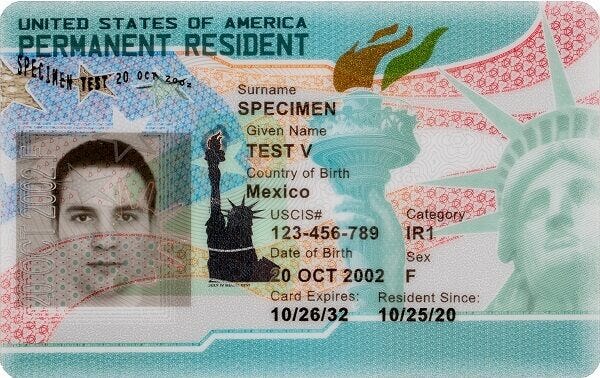
Literally the photo from the Wikipedia entry for “green card”
I’m not great with colors, but this seems more aquamarine than green?2
“Adjustment of status” is the basic legal process which controls how someone who is presently located in the United States can become a lawful permanent resident (“LPR”). LPR status (aka the “greencard”) is not legally available to most undocumented people presently in the U.S., but it is the ideal outcome for anyone is eligible and wants to remain in the country and a necessary prerequisite for U.S. citizenship in any case.3
As the name would suggest, “adjustment” is not a radical act. It is a transition from one completely made-up state of legal existence in the eyes of the law to another.4 In actual practice, it requires nothing more of the government than the costs of the staff required to review individual cases before issuing a fancy piece of paper and a plastic ID card to those who qualify.
FROM THE TOP: WHAT DOES THIS THING SAY THAT IT IS DOING?

We already took a look at the subject line of this memo last time, but let’s just get one more look at it:
“Adjustment of Status is a Matter of Discretion and Administrative Grace, and an Extraordinary Relief that Permits Applicants to Dispense with the Ordinary Consular Visa Process.”
This is a whopper of a title for a government memorandum! It is a bold statement of policy, but I will argue below that it writes a conceptual check that the body of the memo never quite cashes.5
This title makes four fundamental claims, only one of which resembles an honest statement of the law.
Let’s start with a quick orientation to these claims and their basic trustworthiness before going any deeper into the memo itself.
✅ Adjustment of status is a matter of discretion. This basic fact of the system is pretty well established and, for reasons I will get into below, absolutely necessary. But this memo also posits a very different starting place for discretion, and very possibly signals an intent to completely redefine this concept and where and how it is used by USCIS adjudicators.
❌ Adjustment of status is a matter of “administrative grace.” The use of this phrase in this context is such a remarkably bad use of precedent that it has to be intentional. I’ll show my work on why this is so wrong below, but you really don’t need to understand anything about the law to know just how wrong this is as a matter of common sense! Under the best of circumstances residency costs thousands of dollars in filing fees, and that’s for applicants who (at their own significant peril) proceed without counsel. It’s thousands more if they do hire a lawyer, and even with a good one it can take years when sometimes even the “easy” cases get jammed up in unprecedented ways. Calling the successful completion of this process for someone who has met every requirement along the way an act of “grace” is an insult to everyone who has done so in recent years, if not to the very idea of grace itself.
❌ Adjustment of status is “extraordinary relief.” This is another remarkably willful misinterpretation of what adjustment of status is and why it exists in the system. As I will discuss below, Congress went out of its way in INA Sec 245 to make adjustment as “ordinary” as possible for those who qualify. Saying that granting residency to people who clearly qualify for it as a matter of law is an “extraordinary” thing to do is like saying that it is “extraordinary” for a beachfront diner to serve lunch to anyone who walks in wearing shoes and a shirt.6
❌ Adjustment of status permits applicants to “dispense with the ordinary consular process.” In the most literal sense possible, sure. I guess? But this phrasing implies that residency applicants should be seen as seeking a special benefit to which they should not be fully entitled, or that they are otherwise managing an end run around the way things “should” be done. Which is certainly sometimes true here as it is in any other legal process; I wouldn’t be much of a lawyer if I hadn’t won my share of cases that “shouldn’t” have worked out for my clients. But to insist in every case on the form of how things “should” be done over the actual function of a healthy immigration system is to ignore the nature and purpose of a process designed to assess both the needs of the nation and the non-citizen (and the citizens who need them here) before it. The premise that consular processing is the default and adjustment the “extraordinary” exception to it is just so far off-base that I just can’t even seriously engage the point.
Now let’s take a closer look at the legislative history of the adjustment process to show just how out of pocket USCIS is with this memo. (I promise that I’ll step out of lawyer mode for Part 3 to bring it back to why this matters so much for actual people.)
ADJUSTING HISTORY
The right to adjust to LPR status as we know it was introduced in the McCarren-Walter Act of 1952, which added Section 245 to the Immigration and Nationality Act. This was of course back when visas were given out under the openly-racialized “national origins” system—one which the MAGA movement is quickly coalescing around returning to—so in many ways going back that far isn’t particularly helpful to understanding today’s law.
But there is also a good reason why we have to go back that far: Congress was trying to solve a particular problem both in the 1952 Act and the amendment which would broaden its application in 1958. Ironically enough, that problem is exactly the one which this memo seems intent on creating: namely, the frustrating reality of forcing people to return to their home countries for final approval of their immigration status in situations in which it would make much more practical sense to allow them to do so while remaining in the U.S.
There is a term of art for people who have done everything which the law requires of them to qualify for a government benefit. That term is not “extraordinary,” a word which by its very definition signifies that you have greatly exceeded legal requirements.
The word that I am looking for here is “worthy.”

“Worthy” was good enough for lawmakers who expanded the INA’s adjustment criteria in the name of family unity in 1958, and it’s good enough now. Contemporary sources at the time indicate that this standard was intended to introduce enough flexibility to account for life circumstances which happened after a non-immigrant’s entry which might give rise to the intent to remain in the US permanently even if they had truly entered without it.
And that that is generally how the law of adjustment was applied around the country, at least until literally three days ago.
I think that “worthy” is a perfectly fine standard all around, honestly. As someone who has never really had any money to speak of, I have been the proud owner of a long line of cars which I would describe as “worthy,” at least in the sense that they had four wheels and a functional engine, did not require excessive maintenance, and lasted more than long enough to justify the relative pittance which I paid for them. They were fine.7
“Worthy” is not “extraordinary.” It is far from perfect, and that’s okay. To the extent that the average American is “worthy,” we have not been (and should not be) expecting much more from the average immigrant.
AN “EXTRAORDINARY” CLAIM
With no good legal justification, this memo turns all of that history on its head and claims that consular processing was always supposed to be the default for everyone, and that only people with “extraordinary” cases will now be eligible to adjust their status.
As an obvious starting point, this position completely discounts the history and importance of INA 245(a) and the explicit Congressional intent behind the decision to loosen requirements for immediate relatives of US citizens. Why would Congress have opened adjustment eligibility up to some visa overstays and people had worked without authorization—people who are otherwise statutorily ineligible for citizenship—when they are married to US citizens if it really intended for adjustment of status in the US to be used only in “extraordinary” cases? Don’t you think that they would have mentioned it somewhere?
This use of the word “extraordinary” in the context of residency applications is not based in law or statute, and to the extent is based in caselaw the authors have to know that it is not a body of precedent which applies to the typical adjustment case. USCIS relies on one sentence out of one Board of Immigration Appeals case called Matter of Blas from 1974 which I will discuss at length a little further below.
“ADMINISTRATIVE GRACE,” HOW SWEET THE SOUND
The history and meaning of the phrase “administrative grace” is also badly misunderstood by this memo, and I think it’s really worth taking a moment to see how USCIS is to use this language in the context of routine applications for adjustment of status.
Although this case is not cited in the memo, the language about adjustment being an act of “administrative grace” originally comes from a Supreme Court case called Hintopolous v. US, 353 U.S. 72 (1957). Hintopolous was a very different situation from the typical adjustment, in that the non-citizen was in deportation proceedings trying to seek relief from an immigration judge through the “suspension of deportation” process.9
Notably, nearly all of the immigration cases that I could find which used this language about “administrative grace” were about people seeking relief in deportation proceedings. Given that applicants in this situation are often potentially within days of being physically removed from the United States, it is more than fair to call judges intervening to keep them here in the face of this and related adverse factrors an act of “grace.”10 But that framework also has nothing to do with someone who qualifies for adjustment of status who is filing through USCIS, and for them to incorporate it this way into the memo is nothing short of intellectual dishonesty.
THE DARK SIDE OF THE BETTER PART OF VALOR

The word “discretion” appears exactly 40 times in this 6-page document,8 and is central to its rebalancing scheme. There’s a good reason why!
Throughout the past 74 years, the adjustment process has been tweaked and refined. It has been narrowed9 and expanded. But from the beginning it has always included one operative word: that upon application the system may adjust the status of anyone who qualifies to permanent residency.
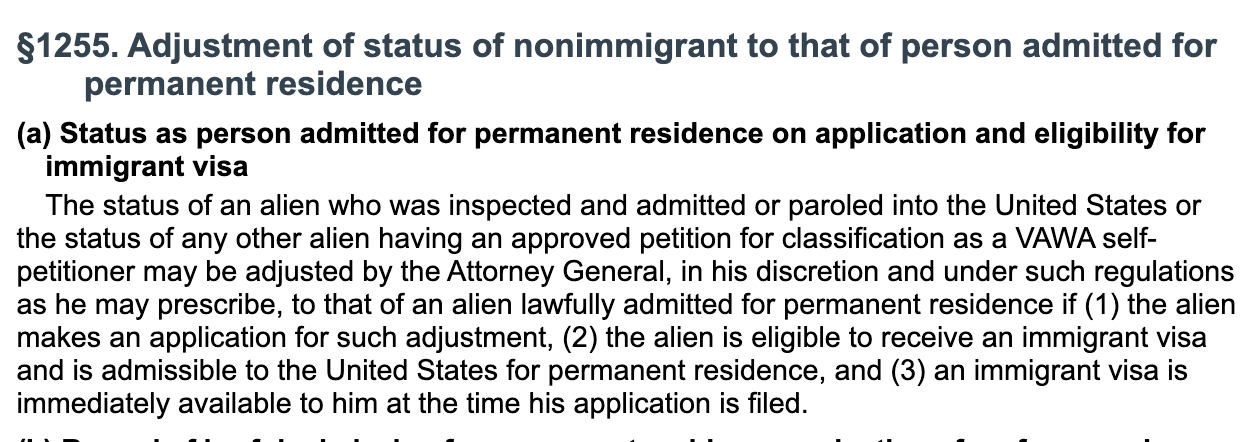
“Mays” and “shalls” are vital signifiers in administrative law.
If a statute instructs that the government “may” do something for an otherwise-qualified applicant we as lawyers know that we are operating in the realm of choice, and adjudicators are (within reason) being given some flexibility to approve or deny the benefit sought based on the unique situation before them. If the law requires that the same person “shall” receive that benefit upon a showing of eligibility, we know that we can focus entirely on proving eligibility without having to move the needle in any other way.10
The substantive difference between “may” and “shall” is the legal concept of “discretion,” which is really just a fancy way to dress up how the reasonable person makes pretty much any decision. Questions like the following may not be as important as someone’s permanent future in the U.S., but still do require real consideration:
Should I put my cat in the kennel while I’m out of town or try to find a pet sitter? How much of my credit card balance should I pay off this month? Can I trust an announcement from a federal agency led by someone who says that Tylenol causes autism?
Discretion does have its limits, of course, and adjudicators are as just capable as the rest of us of reaching the wrong decisions for the wrong reasons.11 It is pretty well established that the adjudicator’s discretion does not stretch as far as granting residency only to white people and/or applicants he finds physically attractive. But unlike the rest of us, they also have to justify their decisions in writing which will be subject to at least some kind of review.
Here are a few examples of actual discretionary denials that I have personally seen or reviewed:
A serial drunk driver. A DUI is probably the most serious criminal offense which doesn’t carry any statutory immigration consequences. But just because the law doesn’t require denial of residency for people with DUI convictions doesn’t mean that they can’t still be heavily weighed against them. Imagine a situation in which an applicant had been charged with three DUIs in the past year. Wouldn’t you want to know what was going on with that person? It is certainly possible that they were going through a mental health crisis brought on by the traumatic loss of a loved one and have since shown full rehabilitation (and are therefore potentially worthy of positive discretion) or that they are an untreated alcoholic (negative discretion, but also a separate grounds of inadmissibility). This kind of inquiry is what discretion is for.
A serial domestic abuser, convicted or otherwise. Anyone who has spent time around the criminal punishment system knows that it can be very hard to hold domestic abusers accountable. While we do want to maintain a system in which people are innocent until proven guilty, it is not hard to put the picture together when faced with an applicant who has faced (for example) credible allegations of sexual and/or domestic violence five times brought by five different women but was never convicted of any of them. The adjudicator is allowed to read the police reports in these cases and come to their own conclusions about what actually happened—and while they are not supposed to give much weight to police reports short of conviction, it can be understandably difficult for judges not to.
People who try to hide or lie about relevant facts. The Supreme Court has held that these misrepresentations do have to be material, or at least somewhat connected to things that matter for residency purposes. So lying about your 9th grade GPA or how many cats live in your house isn’t going to be a problem, but lying how you most recently entered the US or the fact that you are wanted for war crimes in the Czech Republic certainly will be.
PUTTING IMMIGRANTS ON BLAS
The memo starts out by citing a 1974 case called Matter of Blas, and repeatedly returns to it. Its dishonest view of Blas and how it is being used to justify the completely new standard that USCIS is now setting for the average applicant says a lot about why this memo exists at all.
The thing about Blas is that is a very good example of the kind of thing that discretion is for. The applicant in that case had completely abandoned his wife and four children in the Philippines and came to the U.S. intending to remain after lying about these intentions to a consular officer. He was ordered to leave by an immigration judge, but married an American woman three months later and sought residency. The adjudicator found that while the applicant had no criminal record or other factors which would usually disqualify him from receiving residency, his mistreatment of his family and failure to support his dependents was bad enough behavior to deny him residency as a matter of discretion.
The memo’s central premise is that consular processing should always be the default and that receiving residency while in the US is some kind of golden blessing reserved for “extraordinary” cases. But that’s just not what Blas says, let alone how Congress wrote the law.
So in doing all of this, USCIS is essentially telling its adjudicators to hold every immigrant before them—even those with no apparent issues whatsoever—to the standard of a dirtbag who had lied on a visa application, abandoned his family, overstayed a departure order, and married an American woman three months after he was supposed to leave in an obvious bid to try to stay. This is frankly obscene, and the fact that a DHS lawyer thought that this was an appropriate precedent for the point that they are trying to make it the memo says a lot about how the entire system is viewing the people before it right now.
Blas was also about what kinds of positives might outweigh a negative factor as serious as abandoning and then refusing to support your children.12 Despite several other major BIA cases finding that applications for residency should be approved in the absence of any negative factors, this memo invents a completely new standard for people who present no negative factors whatsoever and forces them to justify why their cases are “extraordinary.” This is not the law, and it should not be the law.
As it happens, there is perfectly good caselaw that the BIA had to ignore to get there: a well-known case from 1970 called Matter of Arai. Arai and its many progeny are not cited anywhere in this memo, but they could not be more clear that where there are no known adverse factors, adjustment should generally be presumed to be granted.
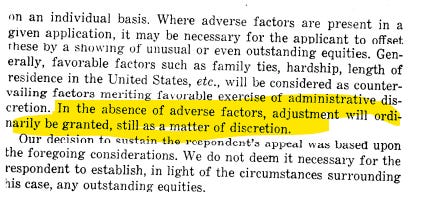
This is the exactly opposite of the position that USCIS is taking here in a memo which does not so much as cite Arai in passing. So there’s that.
WHAT DOES THIS ALL MEAN?
TBD, honestly, but I will say again that I don’t think that the actual text of this policy memo—quite a lot of which is actually fairly routine, and when it is being honest it doesn’t even get at least half of the law it cites wrong—fully matches the dramatic tone of the subject line.
And just to reiterate this point from Part 1, the memo pretty clearly spells out the people who will still be most likely to have a very good chance at adjusting to residency. They will just have to put in a bit more effort to do it—but at this point even the simplest residency cases should not be handled without a lawyer, so please just find one and let them do the work. It’s what we’re for.
As regular Opening Arguments listeners know by now, I have an especially perverse obsession with how the legal facade which American fascism requires is being built right out in front of us—and how and where the inspectional services of our democracy are choosing to sign off on the construction permits. This memo is a crude blueprint for an extremist anti-immigrant agenda which is bound to fail—but watch this space.
Next time: the very human costs of all of this, why courts will inevitably take a wrecking ball to it within the next few weeks, and why the only way through to residency for many people might be getting themselves put into deportation proceedings.
The original text of DeMille’s speech was referencing the Ten Commandments, rather than the law generally. It is often quoted with “the law” replacing “the Ten Commandments,” and while that was not how he wrote the speech I like it much better that way and have also used the same modification. I have to think that the man who said that storytelling is “the greatest art in the world” would approve.
Although then again “food stamps” haven’t been issued on actual stamps since before the turn of the century, and “welfare benefits” has not been an actual legal term since who can even remember when. There’s a PhD thesis in there for someone re: how colloquial names for government benefits perpetuate themselves long after the underlying benefits no longer exist
Okay, not any case. U.S. military servicemembers have a fast-track to naturalization after at least one year of peacetime service (and much faster during wartime) no matter their legal status. (There is also a reading of the INA provision which governs naturalization by operation of law which I particularly like which would allow non-LPRs to automatically naturalize under certain circumstances once their parents have, but that’s never really stuck.)
Or in certain cases from one completely made-up state of legal non-existence in the eyes of the law to a state of legal existence
I am also prepared to concede in Part 3 that it does not even matter what the memo says so long as the subject line is accepted as a valid position for the system to take.
And I suppose if you really want to extend this analogy, manages to get through the meal without physically assaulting or otherwise disturbing fellow patrons and is able pay their bill and tip their waiter without incident
A more objective observer conducting an analysis of my vehicle ownership history based in desirability might reasonably conclude that these vehicles were “falling apart,” “looked like at least one person had been murdered with a knife in the back seat,” and/or “sucked,” but that is a very different assessment than value for money paid
The word “immigrant” appears 31 times; “immigration” only 18
At one point excluding the entire Western Hemisphere!
One helpful way to understand the difference is the example I have often given in my class of the two halves of a family-based residency application. A visa petition must issue
or the right decisions for the wrong reasons, or the wrong decisions for the right reasons.
Notably just because I needed to mention it somewhere, Blas was yet another case along the lines of those in the “administrative grace” section of someone seeking residency while in deportation proceedings rather than going through the usual process