
DID DHS JUST STOP PROCESSING GREENCARDS? A CLOSER LOOK
An attorney who has been helping people through the immigration system for 20 years answers your questions about USCIS's stunning new policy announcement
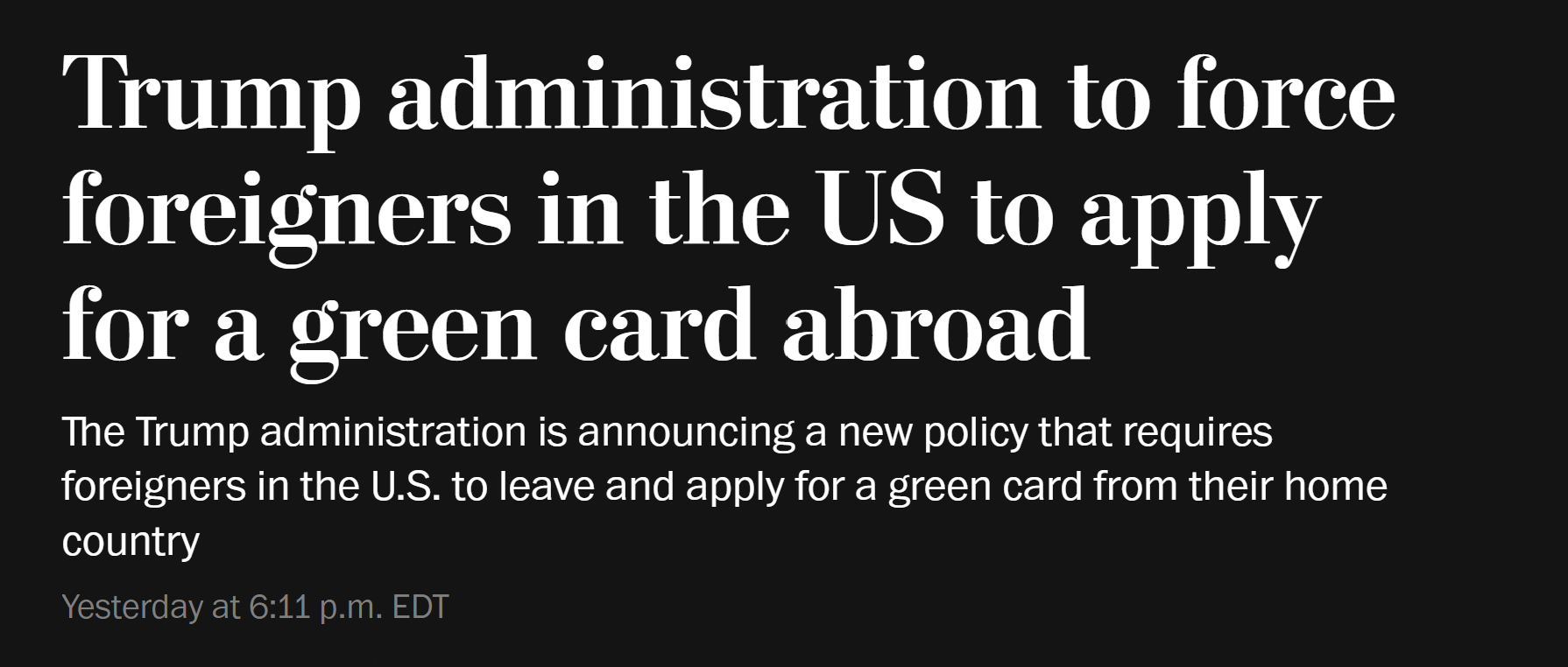
The Washington Post isn’t helping (5/22/26)
“Immigration policy should be generous; it should be fair; it should be flexible. With such a policy we can turn to the world, and to our own past, with clean hands and a clear conscience.”
—John F. Kennedy, A Nation of Immigrants (1958)
“We cannot break the Ten Commandments. We can only break ourselves against them.”
—Cecil B. Demille, “The Ten Commandments and You” (address given 5/31/1957)
The following information is provided only for educational purposes. Immigration law can be incredibly complex, and individual cases can vary in surprising and unexpected ways depending on your personal history and circumstances!
DO NOT TAKE ANY OF THE FOLLOWING AS LEGAL ADVICE AND CONSULT WITH A QUALIFIED IMMIGRATION ATTORNEY BEFORE MAKING ANY DECISIONS ABOUT YOUR OWN SITUATION. I WOULD TRULY LOVE TO BE YOUR LAWYER AS SOON AS TODAY, BUT UNTIL WE HAVE A WRITTEN AGREEMENT AND A PAID RETAINER I WILL NOT BE ABLE TO PROVIDE YOU WITH SPECIFIC ADVICE TAILORED TO THE UNIQUELY SPECIAL LEGAL SNOWFLAKE WHICH YOU UNIRONICALLY ARE.
HERE IN PART 1: You’ve got questions, and I’ve got answers with receipts.
NEXT UP IN PART 2: How the immigration system’s traditional understanding of “discretion” in the immigration system has just been intentionally rewritten to feed Trump’s mass deportation machine
AND FINALLY IN PART 3: The truly heartbreaking part of this story that the media has gotten wrong, and where I think all of this is going
My immigration law office has been flooded with call and emails since media reports of yesterday’s USCIS memo announcing that the usual process for obtaining permanent resident status (aka the “greencard”) is functionally dead and the immigration system was “forcing” otherwise-eligible applicants to process their applications abroad.
Is that really what this memo says?
Did U.S. Citizenship and Immigration Services just “end greencards”? Are people who have followed all of the rules to gain permanent status through family or employment really going to be denied residency unless they leave the country first? Should people who already have their residency be worried? What about people with pending applications? Who is most at risk, and who might be safest from this policy?
Let’s get into it.
Okay. Are greencards over?
No.
But this guy on TikTok said—
Please do yourself and your mental health a favor and step away from the TikTok and Instagram “experts” who are yelling into their phones about immigration a dozen times a day in videos with titles full of capital letters and siren emojis. Viral videos are never a particularly good source for reliable information in the best of times, but they are truly just not it for subjects this complicated.
Even the lawyers?
Especially the lawyers. But also the non-lawyer “specialists” and people who allegedly “work with lawyers” who are out there causing unnecessary anxiety to their own ethnic and linguistic communities, usually while also trying to sell them worse advice and poorer service than you would get from an actual lawyer—often for far more money.
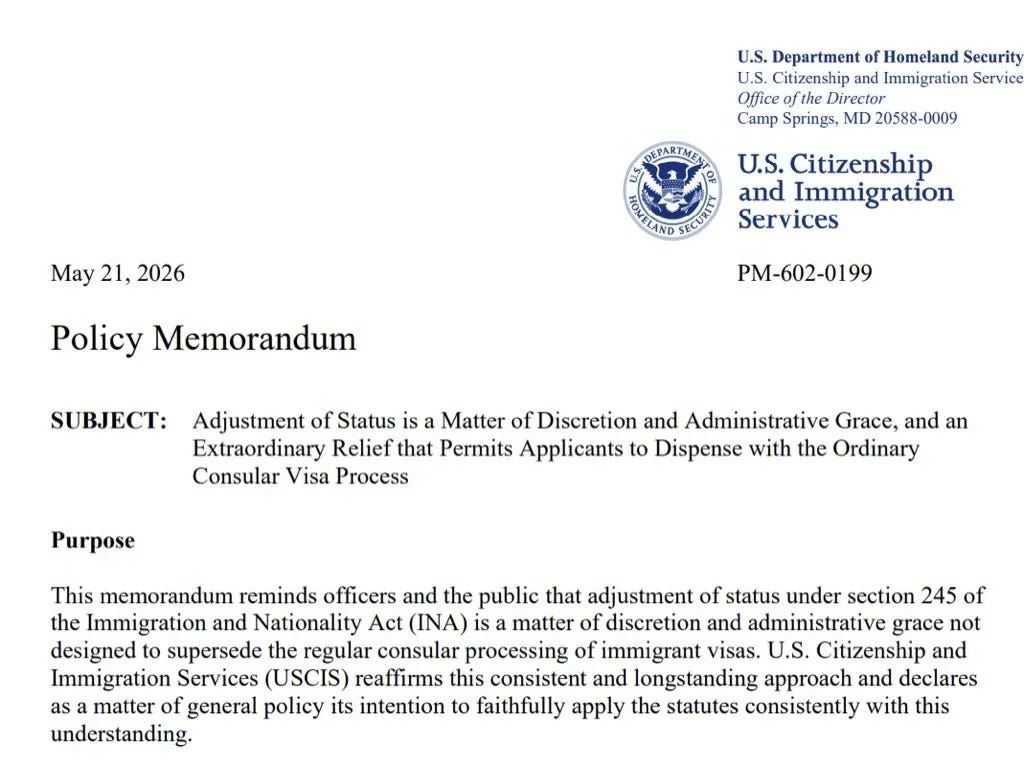
So what’s the deal with this DHS memo?
Let’s start here: it’s a memo.
It’s not a new law passed by Congress
It’s not a new regulation put out by DHS.
It’s an anonymous unsigned1 policy directive which provides a summary of USCIS’s interpretation of existing law and instructs adjudicators and staff on how to proceed with certain residency cases.
Notably, it is also a memo announcing that more memos are coming. This thing is big on sweeping language and really short on details, so for even as much as experienced immigration attorneys and policy experts can read into what we do have here I’m still waiting to see what DHS has to say about some of the more distinct legal situations which I am going to spell out below.
One more thing to remember as you read on: This kind of internal administrative memo is not the kind of thing that usually makes the news—except when, as in this case, the Trump administration really wants it to make the news and give them exactly the kinds of scary headlines that will discourage non-citizens from exercising their rights.
But this is pretty bad, right?
Yes. It is. It is both much better for some people and much worse for others than most of the mainstream reporting has been able to convey—but that certainly doesn’t mean that here to tell you that I’m not worried. To be as clear as possible about this: I believe that this memo was issued in the worst possible faith for the worst possible reasons by a DHS with a mass deportation agenda directed by white supremacists who genuinely want to end as much future non-white immigration to the United States as they can. But as I will discuss below there is still room for hope for many people and far more nuance to this than “everyone is going to be forced to leave the country to seek residency.” In Part 3 I will get into the limitations which federal courts will inevitably impose2 on the government’s ability to actually do anything like that.
Just as importantly, it is also much more complicated than the title of this memo or the headlines would suggest, and as always with immigration news you shouldn’t trust a headline or a thirty-second social media video to explain it to you.
I am trying to understand this because either I or someone I care about is applying (or about to apply) for residency in the U.S.
Before I say anything else about this memo: once you finish reading this to get a better understanding of what this all means generally, you should absolutely find and consult with a qualified immigration attorney for a careful look at your exact situation.
This is your life, and your future. It is too important to take chances.
DO NOT TRY TO DO THIS YOURSELF.
DO NOT TRUST ANYONE PROMISING EASY ANSWERS.
DO NOT SEND MONEY THROUGH WHATSAPP TO PEOPLE THOUSANDS OF MILES AWAY CLAIMING TO BE LAWYERS OR EXPERTS.3
DO NOT FOLLOW THE ADVICE OF ANYONE WHO IS NOT A LICENSED ATTORNEY WITH DIRECT EXPERIENCE WITH THE US IMMIGRATION SYSTEM, OR LET ANYONE LIKE THAT FILE ANYTHING FOR YOU.
Okay, okay—I get it, you didn’t have to yell at me!
Sorry. I’ve just seen too many people misled and ripped off for more money than I ever would have charged them only to be put in far worse situations than they started in. It’s so, so frustrating.
Got it. I’ll start looking for a lawyer I can trust as soon as I’m done reading this. Can we get back to the memo?
Right. Yes. I want to take you through what this document is saying—and what it is not saying.
Let’s start with the memo’s subject line:

This is quite a headline! For anyone who follows US immigration law and policy, this one sentence is a real Mandela Effect moment—a stunning realization that we have crossed over from the reality we were in before we know of the existence of this memo and the alternate reality this memo has created in which the way that most people have been granted permanent residence status while already in the US is now going to be treated as an exception to the rule, rather than the rule itself.
To put this in a more familiar context for most people: Imagine if your local police chief held a press conference to announce a strict zero tolerance policy for speeding in your town. Under this new policy, any cop who clocks a driver going even one mile above the posted speed limit would be required to issue a ticket for the maximum penalty allowed by law, with exceptions made in only the most “extraordinary” cases. The DA then takes the mic to announce that her prosecutors will be participating in this program by bringing criminal charges against even the most minor offenders whenever possible, with recommendations for jail time in every case.
And even worse: these authorities are up there telling the media that this has always been the law and there is really nothing new going on here!
Does any of that sound fair, or like the kind of place you’d like to live in?
Not really! That speeding enforcement plan sounds like a wildly irresponsible and unfair use of taxpayer resources to enforce a stupid policy that no reasonable person would actually want to have to live with which would end up being very bad for the town’s population, reputation, and economy. Who would ever want to move to a place like that, or buy a house or start a small business there?
Pretty much!
Is this memo really saying that USCIS can deny residency to people who otherwise clearly qualify for it?
Yes. But it is also correct in saying that this has always been a part of the system, if very much not the way that USCIS is now saying that it has been. (More on this point in Part 2.)
So just looking at the title of the memo again, what is the difference between “adjustment of status” and the so-called “ordinary consular visa process?”
The most basic explanation is that it’s the difference between filing and waiting on your residency case in the US or doing the same in your home country. But in practice it can be wildly different experiences with very different consequences for people in different situations.
What kinds of situations?
For the purposes of this memo, people eligible for residency without leaving the US under current law mostly come down to what I would define as four distinct categories. I will order them from what I consider to be the least to the most risk, complete with color coding the risk below after reminding you yet again that
THIS IS LEGAL ANALYSIS AND NOT LEGAL ADVICE
🟢🟢 🟢Applicants who are required by law to apply for residency without leaving the country. These people are all still protected by law and this changes nothing for them. Most applicants for residency in the US are applying through family or employment visas under INA 245(a), which seems to be almost entirely what this memo is about. However, there are a handful of others who are categorically excluded from this announcement, including non-citizens who are eligible for residency through: (A) a final grant of asylum, (B) Special Immigrant Juvenile visa recipients, and (C) Humanitarian visas for survivors—including those eligible under the U (serious crimes), T (trafficking), and Violence Against Women Act (abusive relationships with US citizens or residents) categories.
🟢🟢🟡 Applicants with no arrest records who entered lawfully in certain non-immigrant visa categories and never overstayed or violated the terms of their status who are now applying for residency through work or family are most likely to receive residency. After a careful read of this memo and 24 hours to think about it, this category is where I think both social and traditional media reporting on this memo have gotten it most wrong, and I want to explain why.
For as short as it is on some details, the memo is fairly clear that USCIS will not be exercising its discretion (more on which in Part 2) for anyone who has demonstrated anything short of perfect compliance with the system and how we expect non-citizens to move through it. But it most certainly doesn’t say that those who have followed the rules in certain visa categories won’t be able to adjust status with the assistance of a competent immigration lawyer, and I think it is wicked irresponsible for people to be talking about it as if it does.
I will explain this part a little more, as it is directly relevant to the next category.
The memo’s central theme is that people shouldn’t be able to receive the privilege of adjusting their status to permanent residency from another lawful status unless they came in on a visa which allows for that possibility AND have fully honored the terms of that visa. This is most clearly stated in this paragraph, especially the highlighted sentence.
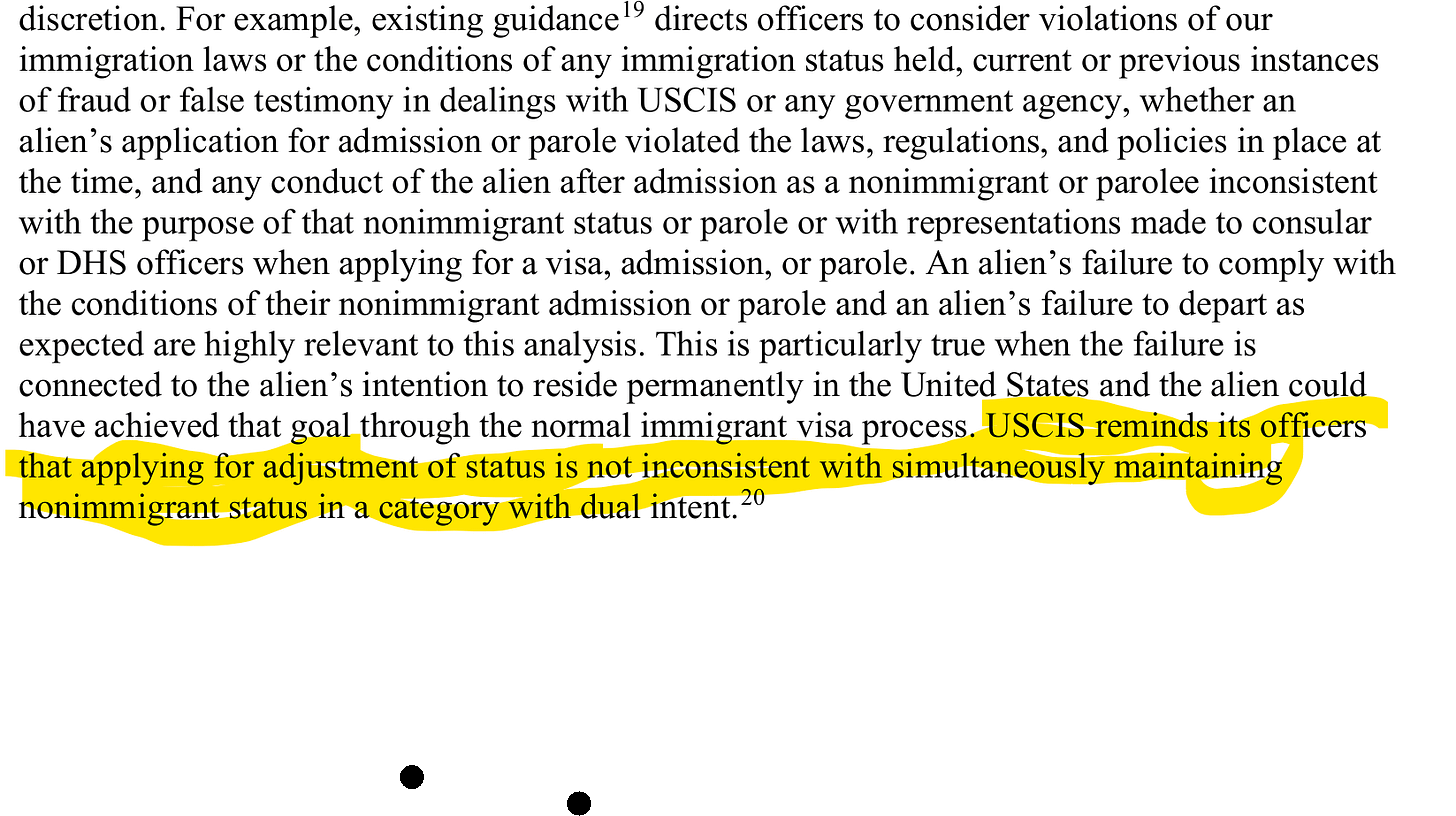
Just to decode this: as the name would suggest, people coming to the U.S. on “non-immigrant” visas are typically permitted to enter the country for specific tourism, educational, or temporary employment purposes. A tourist who demonstrates “immigrant intent” (e.g. signing a lease or starting a full-time job) may be kept from residency later because this intent violates both the legal terms and the obvious statutory purpose of a B-2 visitor’s visa. This memo essential says that since they originally came for a specific limited purpose, they should also be denied the opportunity to transition from a non-immigrant visa to permanent residency. They told the consulate they were just coming to visit, and they were allowed in on that basis. That was the deal they made, and it is now the one that they will have.
If I am coldly assessing this as a matter of policy, that checks out fine. It is perfectly logical. But strictly applying the letter of the law4 to people with family, employers, and communities who are depending on them is horrifically bad policy. (The JFK quote up top says it all.)
However, there has always been such a thing as a “dual intent” visa, by which you can enter the US with the intention to leave and still have the flexibility to transition to a permanent status without leaving if you find a good reason to stay.5
The best-known example of a dual-intent visa6 is the H1 for temporary skilled workers. The H1B is most commonly associated with Silicon Valley, but it also provides valuable staffing for rural hospitals and (for better or worse) Wall Street. These visas may be extended for up to 7 years, and as with the 4-year student it only makes sense both for the national interest and the potential immigrants themselves to allow people in this category to seek out permanent opportunities to remain in the U.S. for both personal and professional reasons.
The paragraph I copied in above says pretty directly that USCIS will continue to allow people to adjust after entering on a dual-intent visa if they have not violated the terms of their status in any way.7 But per clarification we have received from USCIS shortly after the publication of the memo, they will still need to prove that their adjustment is in the “national interest” or otherwise benefits the U.S. A good lawyer should still be able to help you to do that.
🔴🔴🟡 The risk to applicants who overstayed tourist visas who would have previously been immediately eligible for residency through close family members is the biggest news here. I believe that this is the category most squarely targeted by this memo, and the one most immediately obvious takeaway here.
US immigration law has always given special breaks to “immediate relatives,” a legal term which is limited to the parents, spouses, and minor children of U.S. citizens.8 The biggest of these are the provisions of law which do not count unlawful employment or prior unlawful presence after a lawful entry against the immigrant. This is an easy concession to make for people who have committed to sharing their lives with U.S. citizen spouses. Or at least it should be. USCIS is essentially establishing a presumption against a positive exercise of discretion for people who they believe “should” have processed their visas in their home countries.
This may sound reasonable, but only if you don’t know just how cruel immigration law is to couples in loving partnerships just trying to do the best they can for themselves and their kids. I’ll get into that in Part 3.
THIS IS NOT LEGAL ADVICE, but as I see it this memo has created a very real risk to these applicants. As I will discuss below, it may actually be a fairly tolerable risk which will still work out in the end. But it is a risk they should know about so that they can make their own decisions.
4) 🔴 🔴 🔴 Applicants with minor but not otherwise-disqualifying criminal records, immigration violations, or other negative discretionary factors, and/or disqualified applicants who need a special waiver to overcome one of these factors.
This memo is a fairly clear statement that applicants with even the most minor criminal or immigration records should no longer expect any breaks from USCIS in all but the most extreme cases for so long as Trump is president. (And if your first reaction to this category was that these are people who probably don’t deserve a break, I’ll get into the kinds of heartbreaking details which are an everyday part of the practice of immigration law which I would hope would help you to reconsider that opinion in Part 2.)
My residency case was filed and pending at the time of this memo. Will this apply to me?
The memo does not say that it will only be applied to cases filed after that date, and based on usual USCIS practice where this is not clearly specified I’d be prepared for the possibility that anyone who has not had a decision on their residency as of yesterday could still be on the wrong side of this.
That said, I also have some faith that federal courts will find that such a remarkably new approach to the process might have discouraged many otherwise-qualified people from filing if it existed at the time, and declare that it would be a violation of the Administrative Procedures Act to apply it retroactively.
What about people who came across the border without inspection?
This new announcement has nothing to do with them, and their situation is no better or worse than it was before. But this is a good opportunity to note that there more people living in this country who are completely ineligible to receive greencards without leaving the country (with potentially permanent immigration consequences once they do) than there are those who could do so without complications before this memo. This category has not changed since the last major overhaul of US immigration law in 1996, and it is much larger than hardly anyone realizes.
What according to this memo makes a case “extraordinary” enough to approve?
Unclear. The memo has not defined what makes a case “extraordinary” enough to approve under the new standard. This is just one way that the scary subject line doesn’t quite match up with the actual content of the memo, but it is the most frustrating one. The best I can say here from a close and considered read is that USCIS is telling us that we should no longer assume that a previously-approvable case is automatically going to clear the hurdle, and that each applicant will have to make their own individual case as to why they deserve a positive exercise of discretion. It looks like we’ll be waiting on future memos for more clarity on this.
What if USCIS denies my case and sends me on to removal (deportation) proceedings?
There are a few situations in which getting in front of an immigration judge is actually the only path to permanent resident status, and this is looking like one of them. If your case is denied by USCIS you still have a second chance to receive residency from an immigration judge. Since this memo is only binding on USCIS, the traditional interpretation of discretion in adjustment applications should still control in these proceedings, and for as scary as it might sound—and for as wasteful of government resources as it is—this really might be the only way for many people to get the status which until the day before yesterday would have been readily granted by USCIS.
Is it really such a big deal to leave the US and process a visa in my home country?
For many adjustment applicants, it really wouldn’t—and won’t—be. For them the practical difference between adjustment through USCIS and visa processing through the US consulate abroad will be the expense and inconvenience of returning home for a few weeks to have a visa interview at a U.S. consulate rather than being able to attend a similar interview in a USCIS field office in the nearest major American city.
For some others, it might be making major life choices about their lives and futures for the next couple of years. There are so many unique situations out there that many people are caught in a kind of hybrid model of adjustment-vs-consular processing which is really the worst of both worlds. They may have to make some decisions about their lives which will range from mildly annoying (“should I renew my lease next month?”) to life-changing (“am I really ready to get married to my partner?”) to downright wrenching (“can I really risk the chance that I won’t be here for my daughter for the next ten years of her life?”).
And for many others, the difference will be ten years or more of waiting before they are able to return as residents—or, at best, a few years of waiting on a waiver application9 to be processed before finally receiving their residency. Sorry to have to yell one more time but DO NOT LEAVE THE COUNTRY UNLESS YOU ARE SURE THAT THIS DOES NOT APPLY TO YOU OR HAVE MADE APPROPRIATE PLANS AFTER LEARNING THAT IT DOES.
I’ll get into each category further in Part 3, but one thing to know: obviously each of these categories come with wildly different levels of stress and inconvenience but the one thing that they all have in common is that before this memo there would have been no question that they would have been clearly eligible for adjustment and had a fair shot a a neutral adjudicator making a decision on their residency applications without having to leave the US.
That is just no longer the world we live in, at least for now.
I am (a) 2-year conditional permanent resident who needs to remove the conditions to receive a 10-year card, (b) a 10-year resident whose card is expiring soon, or (c) ready to naturalize to US citizenship. Should I be concerned about this memo?
No. This memo clearly and unequivocally only applies to people who have not yet adjusted from a non-immigrant or parole status to permanent residency. Different rules apply once you have adjusted, so even 2-year conditional residents are safe here.
I’ll end Part 1 here with an invitation to submit more questions in the comments which I will update this post to include and answer.
NEXT UP IN PART 2: a deeper dive on how the Trump administration has twisted one of the most important concepts in the immigration system in service of the mass deportation machine.
DHS policy memos are typically issued in the name of the director or legal counsel for the relevant agency. This one does not have anyone’s name on it and is unsigned. I don’t know how much that really matters, but notable enough for a quick footnote at least.
This is not to suggest that federal courts are not also deeply rooted in white supremacy, but there are still far more honest federal judges who will apply the rule of law out there than not and even this SCOTUS has (so far) not been rubber-stamping the worst Trump 2.0 immigration policies.
Nothing the Trump administration has ever done has ever made me angrier than some of the scams I’ve seen targeting desperate people who just want answers—most egregiously, fraudsters taking advantage of the good name of Catholic Charities (one of the most historically helpful providers of free immigration legal services) who pretend to be lawyers and extract tens of thousands of dollars from hard-working people who are terrified of deportation. I’ve seen plenty of these for myself, but this ProPublica story is essential reading.
And for what it’s worth, this is all civil law—nothing I’ll be discussing here would implicate any criminal charges for any of these people
99% of these reasons come down to love and/or money
The other most popular example is the F-1 student visa, which is in a strange kind of place between single and dual-intent after an update a couple of years ago. These are typically college students pursuing a 4-year undergraduate degree. People who have spent this much time and money in the US deserve a chance to permanently make a place for themselves here even if their original intent was just to stay for long enough to finish the degree, and given the unique hybrid-but-not-quite-dual nature of this visa I believe that students who have otherwise complied with the terms of their visas should still have a good chance to make a case for residency even under this memo.
I am indulging my usual footnote fetish with a footnote about a footnote—specifically FN 20, which reminds adjudicators that simply maintaining dual-immigrant status without any violations is not enough unto itself to warrant a favorable exercise of discretion. In other words, should no longer assume that they will automatically get residency as a matter of course just because they did everything right.
The fact that greencard holders do not have immediate relatives as a matter of law is just one of the many bizarre little Kafka-worthy quirks of our immigration system.
The memo does not specifically mention waivers, as it is is focused only on people who are eligible for adjustment of status (which by definition anyone who needs a waiver isn’t). But given the standard it is establishing for discretion here and the fact that a waiver is by its very nature nothing but an exercise of discretion I am not at all optimistic about them.
Hi Matt,
Thanks for this. I can only imagine how many emails you received like mine on this topic yesterday. In terms of things to add to this, I'd appreciate your addressing my son's category, which I think fell through the cracks:
"Applicants with no arrest records (and who never worked illegally) who entered lawfully in certain non-immigrant (student) visa categories *but did overstay*, who are now applying for residency due to marriage to an American citizen."
Also, would a denied application often mean immediate capture by the Bad Guys and/or immediate deportation?
Your work here is invaluable. Thanks again!
F1 s have become a weird little hybrid animal since the latest DOS field manual update a couple of years ago which essentially acknowledged that they are de facto dual intent following BIA precedent--but you make a good point, I have relegated this part to a footnote to avoid confusion. Here's more on that recognition
https://blog.cyrusmehta.com/2024/01/uscis-policy-manual-recognizes-dual-intent-for-foreign-students-as-expressed-in-matter-of-hosseinpour.html